Showing posts with label food. Show all posts

Thursday, November 24, 2011

Thanksgiving Recipe: Maple Mustard Green Beans

To those of you in America, Happy Thanksgiving Everyone! And to everyone else as well, I hope your life today is blessed with friends and family, good food and good company. Here's one of my favorite Thanksgiving recipes, something everyone raves over every year. Forget those nasty green beans with canned crunchy onion things on top. Even if you're not celebrating today, this is a great way to cook up some yummy veggies. Make sure you make plenty, because these are leftovers that are worth having extras of!


Maple Mustard Green Beans

2 lbs Green beans, stemmed and boiled for 5 - 8 min just until tender
2 Tbs Dijon mustard
3 Tbs Balsamic Vinegar
1 1/2 Tbs Maple Syrup
2 Tbs Olive Oil
2 Tbs chopped green onion
Salt and pepper to taste

Mix all of the ingredients and pour over the hot green beans. These taste better the longer they marinate. Enjoy!

Wednesday, November 09, 2011

Raising Healthy Kids: Eat Your Vegetables

How many times have you heard this mind-boggling phrase: "I can't get my kid to eat vegetables."?

Or maybe "My kid just doesn't like vegetables"?

It always leaves me wondering if, at some point, without me realizing it, eating vegetables stopped being considered crucial to good health.

Because they are. And if they're crucial to good health, our kids should be eating them. Period. Non-optional. In our house, this falls under the Ironmom Tough Shit Policy. In other words, Tough Shit kid, you're eating your vegetables.

Of course, it's not quite that simple. In reality, there's four key things I do to keep my kids eating healthy.


1) Model healthy eating. This is the hardest one. I was busted out by my daughter yesterday for taking a sugary sample from the Trader Joe's sample lady when we had set ourselves out on a post-Halloween no-sugar challenge. Whoops! Setting a good example is hard work dammit. But it's essential step numero uno if you want healthy kids. Filling our own plates with veggies is the best way to send the message that this is the way to healthy eating. "Do as I say, not as I do" never ever works.

2) Explain why vegetables and fruits are essential to good health. Do not rely on your kids "Health" classes to do this in school. Chances are, there's a Coke machine right outside the classroom door. Although some school are catching up (one here in town actually has a garden), you can't rely on anyone but yourself when it comes to nutritional advice.

Information is a powerful tool. A friend of mine once told a group of our kids "if it says Hydrogenated on the label, just substitute the words "cancer-causing". My kids became ardent label-readers and to this day, they will turn down even the most delectable treat if the word "hydrogenated" appears anywhere on the packaging. That was a great lesson for me to not shy away from letting my kids know exactly why I make the food choices that I do, in powerful language.

3) Make it non-optional. This is where the Tough Shit Policy comes into play. You are the parent. They are the kids. They have to do what you say. Now I think my kids would tell you that I very rarely employ the Tough Shit policy. I'm a big believer in picking which hill you want to die on. But when it comes to nutrition, I'm ready to stand and fight.

"A meal is a protein and a vegetable, with an optional fruit" is something you'll hear around our house frequently. That's just me reminding the kids of how to prioritize their eating. Except for breakfast, every meal or snack I set out has vegetables in it, or vegetables on the side. Not eating your vegetables? Not an option.


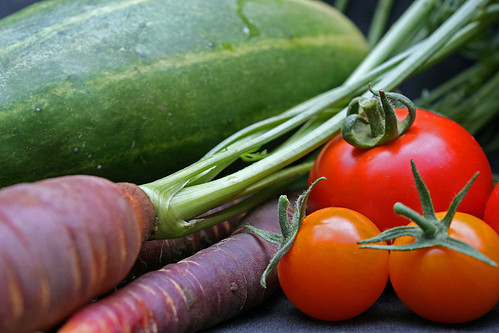
4) Make it fun. It's not like I force my kids to eat things they hate. They can go to the farmer's market or store with me and pick out whichever veggies and fruits strike their fancy. We like to include all sorts of different veggies in our repertoire: jicama sticks, snap peas, lightly steamed broccoli with teriyaki dipping sauce, carrots with hummus, cucumbers with tzatziki, seaweed snacks, kale chips, and the good old Big Ass Salad. Having our own garden for years has been the best way to make sure they eat lots of veggies. When you can go out the back door and pick the snap peas yourself, they taste infinitely better. And we can grow fun stuff like purple carrots and little orange tomatoes.

So this is how it comes to pass that when we went to a Red Robin's for dinner on a road trip recently, my son orders a chicken caesar salad, and my daughter asks for a steamed veggie teriyaki bowl (which has been her favorite for years and for some reason they just cut from their menu. Boooo Red Robin!). It never ceases to amaze the waiters. The fact that they always comment on my kids' food choices makes me realize how rare they are.

With the words "childhood obesity epidemic" on everyone's big worry list, it's clear that it's time to take kids' nutrition back into our own hands and put the phrase "Eat your vegetables" back into the national vocabulary.


Wednesday, November 02, 2011

Why I Threw Away My Kids Halloween Candy, A Manifesto To Feeding Kids Right

It's National Eat Crap week here in America (otherwise known as the week after Halloween) and the question on so many parents' minds is "How do I raise kids to make healthy food choices in the face of all this crap?" So I thought I'd start off by showing you an image of all of the Halloween candy I threw out. No, this wasn't the candy from this year. This was last year's candy! I discovered a little ant trail going across our basement wall and followed it to a cupboard where I found several pounds of last year's candy just hanging out. The kids had forgotten about it. Yep, you read that right. So I threw it out. I'll probably do the same with this year's hoard at some point (hopefully before the sugar ants discover it).

See, I'm of the mind that if you raise your kids to eat right 99% of the time, then a few days of candy overload really won't kill them. And chances are, if they know what it feels like to feel healthy, they won't like how they feel when they eat too much candy, and they might just forget about that stash after awhile.

Wouldn't it be nice if kids came with an instruction manual, and maybe some of those little packets of food like those Sea Monkeys I ordered from the back of a comic book when I was 10? Just sprinkle some in, and they're good to go. And wouldn't it be great if there wasn't a little Sea Monkey 7-11 around every corner just brimming with crap, not to mention all the TV ads for crap food, the crap aisle in the store and the crap dispensers right next to the cash register so your kids can pester the crap out of you begging for crap when you're trying to pay for groceries (aka Real Food)?

So what's a health conscious adult to do when it comes to feeding their kids?

The two key things I've discovered about raising healthy kids are:

1) Be a Role Model. You can't expect your kids to do it if you don't. If you eat like crap and don't exercise, chances are they will too.

2) Cook real food. That means meals, cooked from scratch. I know that's anathema to a lot of folks, and far too many of us have forgotten what an actual homecooked meal looks like. But it doesn't take near as much time as you think it might once you get in the groove.

So that's all fine and dandy, but what do you actually feed the little sea monkeys? Trimama Laurel sent me an email earlier this week asking what types of paleo foods my kids like to eat. Now my kids aren't 100% on the paleo bandwagon, but they do eat gluten free, and only local raw goat's milk for dairy. And since I eat paleo, that's what they eat by default most of the time, unless they talk me into cooking something special for them.


A lot of our meals are very simple and look like this:

Some form of meat, a lot of veggies, and a piece of fruit. The meat might be roasted chicken, a hamburger, some steak done up fajita-style, or some tuna fish. The veggies might be salad or carrot sticks or some kale chips. And this time of year the fruit is likely to be an apple or pear apple off of one of our trees. In the winter, the kids like frozen berries that we picked in the summer for a snack.

Other meals might involve a few more combined ingredients. Some of my kids' favorites:


Omelettes or scrambled eggs
Sloppy Joes without the buns
Veggie/Chicken Shisk-A-Bobs
Taco salad night
Chicken Curry (I usually throw in zucchini, onions, carrots, and any other veggies I have lying around)
Smoothies of many varieties
Teriyaki Chicken
Bacon, bacon, and bacon
Cauliflower "pasta" with meat sauce
Chili
Soup


Special things I will cook for my kids are: "Paleo-ized" waffles, pancakes, or crepes. I basically take the ol' Betty Crocker recipe and substitute my own mix of almond meal, coconut flour, ground flax seeds, chia seeds, and tapioca flour, throw in a couple of extra eggs and some coconut milk, and these make up some tasty and protein-dense waffles (or pancakes). Often, the kids use these as snacks through the day, and I like them for pre-workout snacks.

The most non-paleo meal I will cook for the kids would be gluten-free macaroni and cheese. I use rice pasta and I make up a white sauce myself using tapioca flour, grass-fed butter, and raw milk. I mix in some sheep's milk Romano cheese and some raw goat's cheddar. Voila, a rainy-day comfort food.

But really, most of the time it just comes down to meats, eggs, veggies, and some fruits. Keep it simple, eat and model healthy behavior (including when it comes to chowing on that Halloween candy), and that's all there is to it!

Friday, August 05, 2011

Ditch the Sugary Gels? Paleo Fuel for Endurance Training

How much money does the average triathlete spend on sugary gels and bars in one year? Now wouldn't that be a scary statistic?  Maybe I don't even want to know, especially considering that most of what's in them is some form or another of sugar, and some flavoring. Maybe a few electrolytes thrown in if you're lucky.

Now don't get me wrong, when I'm racing I know that my body starts shutting down digestion in ever more serious ways. It starts gently but by the time you've been out there five hours or more, there's very little that you can put in your stomach that will actually make it to your bloodstream. Simple sugars are one of those few things. Even the coke that I wouldn't normally ever touch will start to be a necessary staple of my existance at Mile 14 of the Ironman marathon. So I'm not saying that there's not a place for gels in the triathlete's arsenal. I'm just wondering how necessary they are in the overall scheme of a year's training plan.

Tomorrow morning's lake swim will probably be about four miles. I'm going to follow that up with a 1 - 2 hour bike ride. Do you think I might get hungry? Yeah, I'm guessing so. I'm trying to take a "train low, race high" approach to fueling my body. Instead of relying on those sugary gels and bars to get me through my Ironman training like I did last time (I shudder to think of how much money I actually spent on that crap!), I'm going to try and use a more whole foods approach for the bulk of my calories, with some gels/bars thrown in for training purposes (never do in a race what you don't do in training is an important truth in triathlon). I know I'm an Experiment of One when it comes to this kind of thing, so I'll let you know how it fares in human guinea pig land.

So what am I eating tomorrow? A breakfast of my favorite Banana-Coconut Custard, which I've recently taken to adding Chia seeds to for a bigger protein boost. I've also made up some Chia gel, which I've created by combining several teaspoons of Chia seeds with some coconut water. I make these up in little tupperwares to take with me. I need to experiment with finding a more gel-pouch-like way to carry them on my bike though. Stay tuned as I experiment with that in weeks to come. I happen to like the Nutiva Organic Chia seeds, and I buy them from Amazon.com as I've found it's cheaper than the bulk food section of my grocery store when it comes to chia. Chia seeds have this absolutely cool property where when you combine them with a liquid, they turn into a jelly-like substance. This makes them easy to slurp down, but nicely high in protein. Sometimes I mix a few teaspoons of juice in, like cherry juice or a berry mix for a different flavor.

For post-race, I'll bring along my favorite "Macadamias Mix Gingerly" nut mix from Trader Joes, which has macadamias, almonds, cranberries, and candied ginger. Yum!

Thursday, July 28, 2011

A Paleo Triathlete's Day of Food

On my recent post on Paleo and Healing, Beth asked if I could share what a "normal" day of eating looks like for me. That's a great idea, and I love to read through other Paleo blogs to get new ideas about food for the day. So yesterday (a fairly typical day for me, food-wise) I logged everything I ate, and here it is:

That's just the raw ingredients of course, but here's what my day of meals looked like:

Missing from the photo is one Lara Bar, so here that is:

I ate the Lara bar just before heading to the lake for a 2-mile morning swim. Washed down with a steaming mug of Yerba Mate tea.

After the swim, it was breakfast time. Typically my breakfast is some combination of eggs and vegetables. Often it's one of my Seven Paleo Power Breakfasts. This morning it was zucchini, onion, mushrooms, and bell pepper sauteed in a bit of bacon grease and combined with a couple of scrambled eggs from my free-ranging chickens.

Mid-morning snack: 1/2 cantaloupe

Lunch: Stir Fry vegetables with shrimp. I sauteed up some snap peas, broccoli, the rest of the zucchini, pepper, onion, and mushrooms and tossed in a couple of handfuls of frozen jumbo shrimp. I use sesame oil, garlic, ginger, and Bragg's liquid amino acids as my typical sauteeing sauce.

Mid-Afternoon snack just before my bike ride: A smoothie with a banana, some coconut milk (also not pictured), a raw egg, some vanilla and crushed ice.

Post bike ride: One half baked yam with some butter

Dinner: Roasted chicken salad. Lots of romaine lettuce, some local chicken, and a olive oil and balsamic dressing I make up with mustard, garlic, and a bit of maple syrup. Two carrots and a bowl of blueberries on the side.

Evening snack: Raw shredded coconut, a handful of Trader Joe's macadamia/almond/cranberry nut mix, and two squares of 88% ultra dark chocolate, with more hot tea.

According to an online calculator, this day's eating provided me with 2094 calories, 212 grams of carbohydrates, 96 grams of fat, and 105 grams of protein. It's important to note that although I eat Paleo, I am not interested in eating "low carb" since I'm an endurance athlete. The two miles of swimming and 25 miles of biking require a fair amount of carbohydrates to fuel. Recently on a triathlon website, someone questioned whether or not a triathlete could compete without bread, pasta, potatoes, corn, oatmeal, and other traditional "high carb" foods. I'm here to tell you that you can! Think of all those empty (not to mention potentially damaging) grain-based carbs, that have been replaced by incredibly nutrient-dense carbs from fruits, nuts, seeds, and veggies.

Similarly, although I definitely hope to get plenty of protein, I typically do it by feel and not by counting grams. I don't tend to worry about fats at all, since all of the fats in my diet come from extremely healthy sources. As someone who only has half of a thyroid gland, having plenty of my fats come from thyroid-healthy coconut is a big benefit.

I'd also note that most of what I eat (with the exception of the tropical things like banana, coconut, and macadamia nuts) is local and easily accessible here where I live. The tropical stuff for me are treats, and I treat them as such. We're lucky to have access to such luxuries, but I try not to make them a staple of my diet. Compared to a soy, corn, and grain-based diet, what I eat is very local in nature. From meat to eggs, fruit, and veggies, most of what our family consumes is locally available, especially in the summer. In the winter, I tend to eat a lot of frozen berries (which our family is picking right now and storing in our chest freezer), and we buy our meat 1/4 cow or 1/3 pig at a time and again store it in the freezer.

Several people locally have questioned my recently displayed ability to heal so quickly from serious injury. When you look at what's on my plate on a daily basis, should that really be so surprising? Compared to the standard American diet, I'm giving my body what it needs on a cellular basis to thrive and maintain optimal health.

Friday, July 08, 2011

Goodbye Nutella, I'll Do You One Betta...

My friend Julie posted this hilarious story about her missing Nutella the other day, and far be it from me to rain on anyone's Nutella parade. I mean, who of us doesn't remember the first time they tasted that chocolatey hazelnutty goodness and thought "OMG, Nutella, where have you been all my life?".But seriously, have you read the ingredient list? Hazelnuts are not the first ingredient, sugar is. Maybe they should call it "sugar spread" instead of "hazelnut spread". Then there's palm oil, and eventually you get to hazelnuts.

Now on the other hand, my little local market carries THIS stuff. One look at the label shows filberts as the first ingredient (that's what we folks around these parts call hazelnuts). You might not know this, but most of the hazelnuts in the U.S. are grown right here in my little neck of the woods. You might've thought that I was the Oregon State Nut but NO, it's the humble filbert. Every fall I run with my dogs through old filbert orchards gone to seed and glean bags and bags of the yummy little nuts.

This spread also boasts organic fair trade dark chocolate as its next ingredient, and moves on to sugar and cocoa butter as well as palm oil. But that's when things get really interesting. Our little dark chocolatey filbert-filled spread has wildcrafted betony on its ingredient list. An herb that's used as a liver tonic and headache cure, betony has a long and very interesting past. A common Roman proverb for someone troubled was “sell your coat and buy betony" and in medieval times you might wear it around your neck to ward off evil spirits. In France, this plant is called herbe du siege, from its roots having been eaten by the garrison of Rochelle during the siege in 1628.

On EatTheWeeds.com, you can read about Florida Betony, which apparently is a tuberous root that tastes something like Jicama. I wonder if the wildcrafted Oregon variety is similar, but there's no information on eating it specifically that I can find. I will have to ask my go-to guy for eating from the wild and see what he has to say about it. Nonetheless, it has found its way into this delicious alternative to the evil Nutella, and I'm not complaining.

On top of all of that, it's strawberry season here, and they're unusually sweet and lovely this year. We're putting up a couple of flats of luscious Benton strawberries, and I found that they go uncommonly well with the dark chocolate hazelnut spread for tempting local treat that's just right.

Thursday, July 07, 2011

Traveling Paleo: Eating Well On the Road

Does this photo look familiar? Have you ever ended up at the "breakfast buffet" of a hotel you're staying at, only to stare at rack after rack of empty bleached white carbs? Eating well on the road is not always easy, but it can be done with a little planning and healthy decision-making.

We recently spent a week near Disneyland since our daughter Asa was dancing in the mouse kingdom with her dance team. The team families all stayed together in one hotel, and this is essentially what the breakfast looked like. Let me tell you, this stuff was so bad that my teenaged son actually took one bite of a donut and left the rest of it on the plate. Usually he eats so much we have to stop him from actually eating the plate ala the Cookie Monster.


Ironically, there was a sign over the only one section with anything that I would touch for breakfast at all. It had exactly this: hard boiled eggs and fresh oranges. The sign said "Healthy". At least they knew what they were talking about! Too bad there weren't a few more options under "Healthy" (the sign appealingly suggested a variety of fruit that never materialized), and maybe they should've had a sign over everything else that said "Massively Unhealthy".

Luckily, we were only a block away from my favorite breakfast stop while visiting Disneyland (yes, I admit we've gone there often enough that I have a favorite restaurant): Mimi's Cafe. Though it's not the cheapest food in town, for a couple bucks more than the sludgy McNasty Meals down the street, you get real eggs, veggies, avocado, and fruit. Those of you who live in the southern half of the U.S. may already be familiar with Mimi's, but since there's none located in the northern half, I'd never been to one before arriving at Disney for the first time. Getting Paleo-friendly fare there is as simple as saying "I'll take an Avocado BLT omelette, please substitute fresh fruit for the muffin, potatoes, and juice. And for dinner, they had some nice "petite" sized meals (read: normal portions instead of overblown American portions), and I had an awesome little sirloin and salad that was delish.

Eating well on the road often boils down to being unafraid to ask for substitutions. Restaurants notoriously fill up our plate with the most worthless (read: cheap) calories: bread, potatoes, rice, pasta. But usually for just a buck or two more (if that), you can substitute more vegetables, fruit, or a salad. This makes even an IHOP or a Denny's into a place that you can eat reasonably well. Sure, it's not a grass-fed free-ranging organic bonanza, but compared to one of these babies...


...it's downright health food.

Thursday, June 02, 2011

Paleo Parenting Is Not Always Paleo Purist

Paleo seems to have hit the tipping point, it's exploding all over the internet. I love all of the Paleo blogs, #Paleo twitter feeds, and informative articles online these days. Great recipes abound and there is plenty of support and information out there. If I get bored or need some food inspiration, it's easy to find a new recipe or the some great articles on nutrition from an evolutionary standpoint.

But, most of the Paleo folks are twenty-to-thirty-something year olds who only have themselves to worry about. Going Paleo is simple, right? You get some meat and some veggies, cook it up or make a Big Ass Salad. Some fruit for dessert and you're good to go. But what if your husband doesn't want to eat that way, and what if your kids eat something completely different? Changing the way your family eats isn't always as simple as just wishing it were so. Even if you feel like they should eat differently, they actually might have a mind of their own. And I'm here to tell you that making three separate dinners is a real PITA when you're a busy mom.

My kiddos are now 11 and 14. They're no longer malleable toddlers who eat what mom says they should. And they're often out and about without me these days, clearly what they eat is no longer 100% in my control. So trying to entice them to eat more paleo has been about finding ways to cook something similar to what they normally might be eating, but in a new way. Fortunately, my kids are pretty game to try my culinary experiments (steamed cauliflower as a pasta substitute went over surprisingly well). And fortunately, they grew up eating a lot of veggies and fruits. It doesn't hurt that they're allergic to cow's milk, which means they've never really eaten most processed food.

Unfortunately, I was a vegetarian when they were little, which meant that they pretty much got indoctrinated with the Veggie philosophies and it took me awhile to first explain and then help them understand why I all of  a sudden felt that eating animals was A-OK (it helps that we buy local humanely-raised meat).

Sometimes, a Paleo meal that satisfies everybody ends up being a Mostly Paleo meal. For instance, we decided yesterday that in honor of the crappy wintertime rainy and sleety cold weather we've been having, we would just pretend it was actually June (instead of the February that got shipped here on accident) and have a summertime meal. Asa wanted Sloppy Joes, corn on the cob, and watermelon. Yum!

Since both the kids are eating gluten-free right now (hey, it's a step in the right direction), we decided to forgo the buns and just have the Sloppy Joe hamburger stuff in a bowl (we couldn't decide if that was the Sloppy or the Joe). Mixing up some local grass-fed hamburger with organic tomato paste (no sugar added) onion, garlic,  paprika, Bragg's amino acids, cumin, and chili powder with a bit of honey for that sweet Sloppy Joe-like flavor came out pretty darned good if I do say so myself. We thumped a bunch of watermelons at the store 'til we found one we liked (I know that's not a local fruit this time of year, but we splurged).

That left corn on the cob. Gasp! It's not Paleo. I could've said no, we're not eating that. Or I could've gotten some for the kids and not eaten any myself. But they would've been disappointed, this I know. It would've ruined the fun little fake-summertime atmosphere we had going. So what did I do? Ate the darned corn on the cob of course! With lots of yummy organic butter, and some cool pink sea salt and multi-colored ground peppercorns. And it was delish. Sometimes the things you do for your heart and your head and your mood and your family are more important than what you do for your stomach. Of course, if I was eating the standard American diet of All Corn All The Time my health would suffer. But on an early June night with some giggling kids and the rain crashing down outside our windows? Well it was just about perfect.

Sunday, April 10, 2011

Seven Paleo Power Breakfasts

Most days my breakfasts look pretty similar: eggs, veggies, maybe some meat or spices. It can get boring, and often I resort to the same old breakfast over and over. Lately I've been experimenting on different combos so that I can keep my breakfast days interesting. Mostly it just requires having a few different ingredients on hand so that I can always switch things up.

So here's a few variations of healthy Paleo-style breakfasts (mostly Paleo, though some have dairy, by which I mean raw goat's milk or cheeses made from raw milk). I add the following to two scrambled eggs (or four if it's for hubby and I):

1. Smoked salmon, spinach, and feta cheese

2. What my kids call "Special Eggs", I scramble the eggs with sun-dried tomato pesto, then add sheep's milk feta cheese and chives

3. Italian-style: Fresh basil, oregano, red pepper, mushrooms, onions, tomatoes.

4. The Bacon Burger: bacon, onions, and ground beef (like a hamburger for breakfast, without the bun!). Slice tomato and avacado on top

5. Taco Eggs: Usually leftovers from the last night's taco salad: sliced tomatoes, ground beef with taco seasoning, grilled onions, roasted chilis. I scramble the eggs with some salsa, and then top heavily with guacamole

6. Shrimp and roasted red peppers with carmelized onions

7. The Mega-Veggie: Sautee onions, zucchini, peppers, mushrooms, and garlic, then throw in the eggs and scramble

Wednesday, April 06, 2011

Is It Breakfast, Or Is It Dessert? Banana Coconut Custard

Athletes love bananas with a passion unparalleled by any other fruit. Paleo lovers feel similarly about all things coconut: coconut oil, coconut milk, flaked coconut, you name it. And if you're an active person, it's nice to have something simple to make, yummy to eat, nutritious, and full of protein, good fats, some carbs, and all the wonderfulness that bananas and coconut bring when combined.

Voila! Enter the Banana-Coconut Custard. I have to admit, I just invented this for breakfast this morning, since I was tired of my usual veggie/egg scramble. Here's the basic recipe:

1 banana, smushed
2 eggs, whipped to a frenzy
4 tablespoons coconut milk
3 tablespoons flaked coconut (large flakes)

I whipped up the eggs, added the coconut milk and blended until creamy. Folded in the well-smushed banana, and the coconut flakes. Then I put it in the microwave for 90 seconds. The middle still looked a little goopy so I put it in for another 60 seconds. As you can see, it rose up in a lovely souffle-like manner and was a light and tasty start to the day. It's a testament to how few sweet things I've been eating that this tasted more like a dessert than breakfast to me.

Monday, March 07, 2011

Orange Cranberry Paleo Muffins: Recipe Makeover

So much of Paleo food is simply not very portable. It makes you realize why people thought sandwiches were the most amazing thing ever. All of a sudden you've got this messy meat stuff all wrapped up nice and neat and easy to eat with one hand. So with a family on the go, it's sometimes hard to find foods you can take on, say, a family hike.

I got this recipe from a friend last year and liked it pretty well for a tasty snack or meal that's portable. But they were pretty dry and crumbly, so I decided to fix it up a little. The original recipe called for almond meal, eggs, and a bit of honey, vanilla, etc. I spruced it up by adding one more egg and some really thick and creamy coconut milk, as well as some lemon extract. I also switched out the almond meal for a combination of almond meal, hazelnut meal, coconut flour, and flax seed meal. What I ended up with is a muffin with a texture that's closer to actual muffins, but packed with flavor, protein, good fats, and a bit of tasty fruit. Perfect for breakfast, or any time you need a snack out of the house.

Orange Cranberry Paleo Muffins

1 C Coconut flour
1/2 C. Almond Meal
3/4 C. Hazelnut Meal
1/4 C. Flax Seed meal
4 Eggs
1/2 C. Full Fat Coconut Milk (not Lite Coconut Milk)
1/4 C. Honey
1/2 t. Baking Powder
1/2 t. salt
1 T. Vanilla
1/2 t. Lemon Extract
2 T. Grated Orange Peel
1 C. Cranberries

Friday, February 11, 2011

Paleo Challenge Report Part 2: What I've Been Eating

A couple of quick notes about the Paleo eating plan and the Paleo Challenge:

1) This is not a diet in the usual sense of that word. Originally, diet meant basically what you eat. Like birds eat a diet of seeds and bugs. But now if you say "I'm eating a Paleo diet", what immediately pops into people's minds is "weight loss". While the Paleo diet seems to induce weight loss in a lot of people, especially if they're typically eating a lot of simple carbs going into it, that's not the main focus (for me at least) of trying to eat this way.

2) The main focus is health, across all body systems. Good health feels like this: You go to sleep easily, you pop out of bed with lots of energy, you can perform all sorts of demanding tasks during the day both mental and physical without feeling tired or lethargic, and your body systems all function well.

Okay, that being said, it seems like eating this way might take some getting used to. So what's a typical day on the Paleo Challenge like? Easier than you might think.


First of all, I try to think of each meal as about 2/3 vegetables, 1/3 meat or other protein. I've tried to get really good about prepping a bunch of vegetables all at once so I've always got a supply on hand of vegetables cut and ready to go for anything I want to cook.


BREAKFAST:

I like to start out my day with a whole bunch of veggies, scrambled up with some eggs or sausage or bacon or even some hamburger left over from last night. For hubby and I, I basically fill my cast iron skillet with vegetables before adding 4 eggs, so there's a good wallop of vitamins, anti-oxidants and protein to start off our day.

Once a week on Sundays, I cook up a big batch of "Paleo Crepes" made with almond meal and coconut flour. I put the extras in the fridge and the kids eat them all week. I usually have them on Sunday morning with a bunch of berries.


LUNCH:

If we're at home for lunch, I might cook up a nice stir fry. Throw a bunch of veggies in the pan and add some frozen shrimp. Toss in some garlic, onions, ginger, a spritz of sesame oil, some Bragg's Liquid Aminos  which add a flavor similar to soy sauce, and you've got a really great lunch in five minutes.

If we're out of the house, I might take along some turkey or chicken slices and a bunch of snackable veggies like carrots, red pepper slices, celery, etc.

DINNER:

For dinner, I try to get creative and find things that fit well with my Paleo desires, but that the kids will also like. Taco Night is a good one, because I just make a huge Taco Salad (with no chips or taco shells), and the kids make regular ol' Tacos.

Other favorites are:

Pasta (I make a big meat and veggie sauce and serve it over steamed cauliflower for myself/hubby and pasta for the kids)


Soup: My homemade chicken or turkey is a huge favorite, and if we roast a whole chicken or turkey I can make an extra meal or two out of it by boiling up the carcass and making soup. I make it good and spicy with lots of veggies and pepper.

Fried Chicken: I've discovered I can make this by lightly rolling the chicken pieces in coconut flour. The kids declared it "delicious". I served it with some big bowls of steamed broccoli. Yum!

That's about it. I try to rotate through stuff so I don't get bored. I try to make sure I'm feeling happy about what I'm eating, and getting lots of fresh and steamed vegetables in there. If I feel like I need a few carbs during a heavy workout day, I'll throw in an apple or some dried fruit. Snacks are often nuts, jerky, or coconut chips (my favorite).

Thursday, January 13, 2011

Stone Age Diet Deserves Iron Age Pan

I'm trying to be really good about putting only the best food in my body right now (oh, I had to turn away and actually NOT LOOK at those Lemon Bars that one of the moms brought for snack time yesterday. Lemon bars! I didn't eat one). No sugar, no grains, just good quality veggies, meat, nuts, and a bit of fruits. The Paleo Challenge is going well, and other than the cold I had at the start, I feel strong and full of energy.

But regardless of the quality of our food, it also matters what we cook it in. Did you know that the off-gassing that occurs when you cook in Teflon and other non-stick coated pans can be fatal to pet birds? Talk about your canary in a coal mine! If it's fatal to birds, what is it doing to us? As it turns out, it's not good. The chemicals used in creating non-stick cookware can cause cancer, and birth defects. Companies like DuPont (maker of Teflon) have already paid millions of dollars in fines and lawsuits because of these issues.

The great thing is, there's an age-old alternative to non-stick pans. It's the good-ole' cowboy standby, the cast-iron skillet (or griddle, or Dutch oven). It takes awhile to get used to cooking on cast-iron. In my case, it was a few months, in hubby's case. Well, let's just say he's still in training and occasionally sticks the eggs to the pan. Once you get the hang of it though, cast iron is a near perfect cooking medium. Here's a few benefits:

1. Cast Iron heats completely evenly across the pan. No hot spots or cool spots.This makes it great for things like pancakes.

2. Cast Iron lasts forever. You could inherit a rusty old cast iron pan from your great-great grandmother, and as long as it doesn't have any cracks or nicks in it, you can scrub it out, re-season it (more on that later) and use it for dinner.

3. They're non-stick when well seasoned and they actually get better with age. The longer you use them and the better they're seasoned, the easier they are to cook with.

4. You don't have to worry about scratching them. You can use whatever utensils you want.

5. You can actually increase your blood iron levels by cooking in cast iron. If you tend toward anemia like I do, this is a huge health benefit.
Researchers found that cooking in an iron skillet increases the iron content of many foods. Acidic foods that have higher moisture content, such as applesauce and spaghetti sauce, absorb the most iron. In fact, for 100 grams of each (about 3.5oz.), the applesauce increased in iron content from 0.35mg to 7.3mg, and the spaghetti sauce jumped from 0.6mg to 5.7mg of iron.
6. You can stick them right from your stovetop to your oven. I do this when I cook a good steak: get my cast-iron pan heated way up, throw the steak on and sear it on each side for about 90 seconds, then put the whole skillet into the oven and bake it for about 5 minutes. It stays nice and tender and juicy on the inside with that seared tasty outside. Yum!

7. It makes a really good weapon in a pinch. I would totally clock an intruder over the head with my cast iron if I had to. Just saying.

How to do it? There are instructions for seasoning your cast iron pan (as well as re-vitalizing old yard-sale or handed-down rusty skillets) on this website. I've found that when I'm done cooking, I just scrub it out with a plastic scrubbie and hot water (I don't even use soap), then put it back on the hot burner until all the water has evaporated. A quick rub-down with some oil (coconut oil works great) and it's ready to use the next time.

The Ironmom Extra Mile:   More great tips on using cast iron here at RichSoil.com.

Thursday, December 16, 2010

A Sugar-Free Dessert for a Winter's Night


In the middle of a cold and rainy winter's evening, there's nothing better than some comfort food. But let's face it, most foods that come to mind are full of sugar and grains. In the last couple of weeks, I've been gleaning apples from trees around town that are just hanging with fruit. Getting to them before the real frosts set in is a must, since after that the apples will be useless. So far I've gotten about fifty pounds worth.

Applesauce may not be what springs to mind when you think of a comfort food, but the way I make applesauce it's more like a warm apple pie without the crust. I like to serve it steaming hot, with just a bit of fresh cream on top. Yumm! I don't add any sugar when I make it. I core and peel the apples, then dice them and throw them in my crockpot with a bit of water and some cinnamon and a dash of nutmeg or other spices. I cook it down until the apple pieces are tender, but not mushy like store-bought applesauce. As my kids say "this doesn't taste like anything you can get in the store!" Best of all, you can freeze it and eat it all winter long. I usually run out just about when the first spring flowers start to poke through. By then, I'm ready for early spring veggies and fruits.

Wednesday, November 10, 2010

Ironmom's Locavore Breakfast and the Dark Days Challenge

Locavore: yet another internet word that has popped up in the last few years. The dictionary manufacturers couldn't even keep up if they ran their presses night and day. Then again, who buys dictionaries anymore when you have Wikipedia at your fingertips? If some terrorist plot took out the entire internet, schoolchildren would fall to their knees in despair at not being able to look up words. I admit, I'm one of those moms who actually makes their kids look things up in books from time to time, just for kicks and grins. If they still kept the Dewey Decimal cards in those little wooden drawers somewhere in the library, I'd probably torture them by making them look up books that way from time to time as well.

But locavore is a good word, a word that wouldn't have a reason to exist a century or two ago, kind of like the fact that there's no word for faith in the Lakotah dialect. If everyone has something, there's no need to name it.  But now locavorism (is that a word?) is a great first step toward food security, environmental stewardship, fostering community, and most important to this Ironmom, eating healthier. Food that comes from local sources is naturally higher in important stuff like Omega-3s, vitamins, and minerals than food that is processed and shipped from far away.

For instance, eggs from chickens who free-range have 20 times more Omega-3 fatty acids than conventional eggs. They also have 10% less fat and 34% less cholesterol, they produce HDL or "good cholesterol" and help lower bad cholesterol. This helps to explain why despite eating eggs for breakfast almost every single day, my cholesterol numbers are far lower than when I was a vegetarian and even a vegan.

So here's what went into my locavore omelette today:

Eggs from our lovely lady chickens. As you can see, we treat them very well! This one, my son's chicken "Voodoo" had a foot problem, so she's getting a spa treatment.  No, I'm not kidding! We treat our chickies very well and as a results they have very few health problem. We let them out to free range around the yard and they take care of our ants and garden grubs, among other things.

Milk from a local goat farmer. We buy this on a weekly basis in 7 big glass jars. This photo is my daughter actually hand-milking one of their goats. She's pretty good at it! We have had a relationship with these folks for many years now, not only just purchasing milk but going out to their house when their goats had babies or their dog had puppies. This is not the same at all as picking up a gallon of milk in a plastic jug at the store. Building relationships within your community strengthens not just your physical health, but emotional and mental health.


Spinach and tomatoes from the garden. I wasn't much of a green thumb when I started vegetable gardening (my house plants tend to even look anemic and wilty) but I've found it's not as difficult as one might think. Even just growing a few of the things we love to eat provides a big wallop of nutritional benefit over produce picked green and shipped long distances.


There's also local pork sausage in my omelette. I don't have a photo of the pig, but we bought part of it (a third to be exact) from the contractor who helped us with our sunroom last year. He just so happened to mention he was about to slaughter his pig (doesn't that come up in everyday conversation around your house?) and we filled our freezer with  a bunch of pork chops and sausage.

The last ingredient is some chantrelle mushrooms. These grow all around the woods in our part of Oregon, and local folks harvest them and sell them by the side of the road or at farmer's markets. Luckily, these are very easy mushrooms to harvest, with no poisonous relatives that your local mushroom gatherer could get confused. They make a very tasty addition to my morning eggs and give a seasonal flair to any meal you add them to, since they're only available right now and not at other times of the year. There are very few things you can say that about any more, with produce shipped from all over the globe, so I look forward to my little seasonal treats. Some year I want to go out in the woods and actually pick some.

Last year I participated in the Dark Days Challenge, which is to cook four meals each month (1 per week) focused on SOLE (sustainable, organic, local, ethical) ingredients with only local foods. I'll be doing it again this year, and if anyone wants to join me, I'll post some updates here with links to your posts about eating local!

The Ironmom Extra Mile:   Jason from Life of an Aspiring Triathlete asks "Where are those goat farmers here in Dallas?" In answer, the website RealMilk.com is a terrific resource for connecting with local farmers wherever you live. In their "Where Can I Find Real Milk" page, I found that there is a goat dairy in the Dallas/Fort Worth area that sells goat's milk by the gallon. The dairy's page is: www.lattedadairy.com. There is also a dairy in that area that sells raw cow's milk. Additionally, this website has dozens if not hundreds of listing for raw milk (cow, goat, and sheep) for all over the U.S. and for other places in the world. It's a terrific resource. So if you want real milk with real nutrients (pastured, raw, and not full of antibiotics and other nasty crud), check out this site.

Sunday, November 07, 2010

Sunday Snap

Something new in my blog starting this week. I'm going to post my favorite photo of the week as my "Sunday Snap". Happy Harvest time everyone. This little squash was just too beautiful to eat.

Friday, November 05, 2010

When Good Veggies Go Bad

It's like a horror movie where some dumb blonde just can't resist going into the dark room even though the freaky music is playing and your fingernails are permanently glued to the arms of your seat. You KNOW what's going to happen. That's how it used to be with my refrigerator when I thought about opening the produce drawer. You know what I mean. Scary creepy moldy slimy freaky Vegetables Gone Bad. You bought them with the best of intentions. They were healthful, vibrant, full of nutrients. They started looking a little wilty and you thought "we really should have some broccoli tonight", but you didn't have the time to cut it up because Tommy's Little League uniform got muddy and Susie couldn't find her pointe shoes for ballet. So the broccoli sat another day. And got meanier and uglier and slimier. Until one day you open the drawer and scream like the dumb blonde in the movie when surprise! the guy with the hockey mask and the freaky dagger hands jumps out to kill her after all.

I used to wonder why the vegetable drawer in my refrigerator was called a "crisper" when what it seemed to do was ensure that my veggies turned into a soupy mess. But fortunately, the freaky slime-vegetable syndrome can be avoided with some proper planning and prep work.I discovered that the key to actually eating my veggies instead of feeling guilty every time I opened my fridge drawer to another slimy glop of former salad is to make them into useful meal-fodder as soon as I buy them. This takes a little bit of time when you get home from the grocery store, but saves time, money, and the disgusting chore of cleaning out the goopy vegetable drawers.

What I do now is plan to go grocery shopping when I'll have about twenty minutes afterward for food prep (no rushing home, throwing everything in the cupboards and fridge and dashing back out again. Then as soon as the vegetables come out of the grocery bags, I wash them and put them on dish towels to dry. After patting them off, I slice or dice them into whatever form I'm actually going to use them in. This means that onions, green peppers, and zucchinis get diced up for use in omelettes, stir-fries, and burritos. Red peppers are in long slices that the kids like to dip in hummus. Carrots get sliced into sticks. Yes yes, I know you can actually buy bagged baby carrots, but I think real carrots taste way better and they last a heck of a lot longer. Plus, the baby carrots only have 70% of the beta carotene of regular carrots. And just for fun every year (and because my kids will eat way more of them) I grow purple carrots in our garden. They're gorgeous!

I also discovered that container shape matters. You might think that whether a container is round or square has no bearing whatsoever on how many vegetables you'll eat out of it. But I found that round containers don't stack as well, take up more space in the fridge, and tend to get pushed toward the back of a shelf where the contents turn evil. Square containers stack nicely, and use space much more efficiently. That means they tend to stay toward the front of the shelves where I use them frequently. I really like these Snapware Glasslock containers that I just happened to pick up one day at Costco.

You still have to eat the vegetables within a reasonable time frame of course. They will eventually go bad, even in glasslock containers. But because they're already pre-prepped, you're so much likely to just throw them into breakfast, lunch or dinner when you're in a rush. You can easily build a salad, an omelette, or a skillet meal in 5 minutes or less when you have your vegetables under control. Side bonus is you actually eat better and save money by not throwing out expensive produce.

The Ironmom Extra Mile: More than you knew about baby carrots here at Wisebread.com

Monday, May 17, 2010

The Fifty-Fifty Run

Sometimes things are best when they're comprised of different components. When I was a kid and the ice cream truck would come around, my dad would always buy us a "Fifty-Fifty Bar", which is one of those orange and vanilla concoctions that they now call a Creamsicle. They don't taste as good now as they did back then, probably due to the fact that they used to be made of vanilla ice cream and something with actual orange in it. Now two of the first four ingredients are corn syrup (there's both the regular and the high fructose kind) and the rest of the ingredients have nothing to do with either vanilla or orange or ice cream. But I digress...

Yesterday I had a long run to do. Hubby wanted to run four or five miles, and my friend Kay wanted to run four or five miles. Put two and two together and I got a half of a long run with one, and a half with the other! After loop one, I just rang Kay on my cell phone and told her I was 10 minutes from her driveway, she met me there and I just kept rolling into the second half of my run. Not a bad way to go: the fifty-fifty run. If you're an athlete doing a long slow day, and you've got friends who don't want to go that long, it's a good way to still get to run together.

This morning I had a tough Crossfit workout to do, involving five rounds of an 800 meter hill run, plus 30 kettlebell swings and 30 pull-ups. Although I have recently graduated back up to using a green (narrower) band on the pull-ups, I had to go back to a thicker band for this workout given that it would be 150 total pull-ups. Still, I'm grateful that my arm is now working well enough to do the pull-ups and the kettlebell stuff, and miraculously my legs felt pretty darn fresh on those runs!

But, now I'm jonesing for a Creamsicle, the real kind of my memories. Maybe I'll have to make up some kind of Creamsicle smoothie with vanilla protein powder and call it good.

Wednesday, May 05, 2010

Gardening Club, Sustainability Discussion Group, Recipe Sharing, and Oh Yeah, Triathlon Training


As our little group of aspiring triathletes is warming up for a training run, the conversation inevitably turns to topics like.....

... whether or not to mulch the tomatoes against a potential frost, best designs for backyard chicken coops, books like Food Not Lawns, or  In Defense of Food, recipes for flour-free muffins, seed saving, or what we want to can, freeze, and store food-wise this summer.

I bet you thought I was going to say heart rate zones, tempo vs. long runs, brick training, and nutritional periodization! For many athletes, sports are a distinct thing that they do, separate from their regular life. And perhaps they eat a little more nutritiously to fuel their workouts, or perhaps they just buy more power bars and binge on pizza. For many of us (and I have definitely been in this camp before) we work out so we can pig out. I used to love the fact that I could eat a pint of Ben & Jerry's because I'd done a 15 mile run that day. Don't get me wrong, it's a definite advantage of the multi-sport lifestyle that we can afford a few more nutritional indulgences since we burn so many more calories. And there's definitely nothing wrong with a pint of B&J's. Especially if it's Coffee Heath Bar Crunch......yummmmmmm

But these days I'm seeing a synergy starting to develop between my athletic pursuits, my passion for sustainability, and my interest in good nutrition starting at the ground level with my garden. When I started blogging several years ago, I created three blogs: one for triathlon training, one for sustainability/gardening, and one for our homeschooling and parenting. As the years have gone by, I've found it harder and harder to figure out where to put many of my blog posts. Is eating directly from my garden an offshoot of the Paleo eating that I'm doing to fuel my body for sports and thus should be posted here? Or is it related to my Urban Farm blog because of its environmental sustainability and ties to local eating, or is it something I do to bring better nutrition to my family and to raise healthier kids and thus should be covered on my Blue Skies blog?  I've toyed with the idea of combining blogs, but I think most of the time it works better to keep them separate because people interested in backyard chickens probably don't want to read my swim workouts and vice versa.

Yet an increasing number of my triathlete friends, both online and in person are planting gardens, getting chickens, buying local meats and produce, and moving toward a position of food sustainability and locavore eating. It makes sense that if you're going to work your body to the maximum, you should fuel it with the best possible sources. So we'll probably be having BRiCk workouts this summer. That's Bike, Run, and Canning green beans!

Wednesday, April 14, 2010

Taking the Starch Out Of Our Easter Crepes


Traditions are important in our family, and special occasions often have special foods associated with them. For as long as I can remember, I've cooked crepes for Easter Brunch. I used to make Key Lime Crepes, which in my opinion are just heavenly, but my kids can't stand the key lime filling, go figure! So I switched to berry crepes. This year, eating in a more Paleo manner (and now hubby and daughter are doing the same), I had to revamp the old recipe. Betty Crocker, meet Grok the caveman!

I was a little worried about my no-wheat-flour version of the crepes since often using coconut flour and almond meal creates a grainier texture that doesn't hold together well. So I subbed 1/4 C. tapioca flour for some of the flour and that made a huge difference. The kids and the hubby all declared that these crepes are way better than the original recipe and that I should always make them this way. A new tradition has been born!

Although they are heaven with strawberries or blueberries, these are actually so yummy that you can eat them plain, and I'm thinking they would make a great biking power food, you could wrap up a banana, some almond butter, or something else yummy inside them as well.

Nutty Almond-Coconut Crepes


1/2 C. Almond Meal
3/4 C. Coconut Flour
1/4 C. Tapioca Flour
1 T. Maple syrup or honey
1/2 t. Baking Powder
1/2 t. salt
2 C. Milk
2 T. Coconut oil
1/2 t. vanilla
3 large eggs


Combine dry ingredients. In a separate bowl, whip eggs and add wet ingredients (tip: when using coconut oil, I make sure to warm it to melting temperature first, and I also slightly warm the milk so that the coconut oil doesn't re-solidify when it hits the batter). Adjust milk content to create a slightly runny batter. Pour 1/3 c.at a time in hot cast-iron skillet and rotate skillet to coat a thin layer of batter in a large area. Flip when golden-brown.