As an endurance athlete, I'm always experimenting with what/when/how much should I eat before, during, and after exercise. It's nice to see some quantitative data that helps this decision-making process. Here's an interesting article on carbohydrate consumption during exercise that seems to peg the optimum carb ingestion at about 70 - 80 g per hour.
While I typically eat a primal/paleo diet most of the time, I do use Infinit as my carb drink of choice on extended (>1.5 hour) bikes and runs. The nice thing about Infinit is that you can personally adjust the amount of carbs, electrolytes, protein, and even flavor to your own specifications and taste. For me, a person who sweats very little (so needs less salt and electrolytes and even less fluid), this is very important. I can increase the density of my drink mix, while dialing down the amount of flavor so that I can get the right amount of carbs and electrolytes while not drowning in fluids that my body simply won't sweat out (there's nothing like that sloshing sound of extra fluids in your stomach while running).
Using my personal formula, I know that I took in exactly 130g of carbohydrates during my 2 hour bike ride yesterday, for a rate of about 65 per hour. I might try upping this with my next batch of Infinit and see if it works better.
If you're going long in your races this year, it's a good idea to start thinking about nutrition now, practicing it on long rides and runs, dialing it in until on race day there are no surprises and no problems. I credit my dozens of nutritional trial runs last year with seeing me through an Ironman on a stomach that was still reeling from the bout of food poisoning earlier in the week. I don't think I could've finished the race if my nutrition hadn't been spot on.
This week on Philosophy In Action, Dr. Diana Hsieh will be interviewing Nell Stephenson on the subject of "Paleo for the Endurance Athlete". I'll be interested to hear if she has any good info for training (other than eat more yams and bananas!).
Showing posts with label nutrition. Show all posts
Showing posts with label nutrition. Show all posts
Tuesday, February 26, 2013


Thursday, December 08, 2011
What Three Plates Of Vegetables Can Do

What is the net effect of those changes? We don't feel them instantly. If we make bad choices, we can't feel our mitochondria shriveling or our liver being taxed. In a way it's too bad, maybe with some more instant feedback it would be easier to make good choices. Or maybe not. How many people have you watched in a coughing fit after smoking a cigarette, but the pack still goes back in their pocket. Unless it delivered an instant electrical shock or something, we humans are very good at ignoring the poor outcomes of our choices in favor of instant gratification (and Mmmmmmm, that Flan is so gratifying...)

At the end of each workout, my muscles feel absolutely flogged. I am certain that the next day I'm going to wake up and be stiff and sore and too fatigued to work out again. Yet miraculously the next morning arrives and I pop out of bed feeling refreshed, energized, and ready to hit another hard workout. The miracle, I am certain, involves what I am eating. Specifically, lots and lots of vegetables, fruits, nuts, seeds, and grass-fed meats.
But don't just take it from me, watch this amazing video, a Ted Talk by a doctor who cured herself of advanced MS with a paleo-style diet. Believe me, even if you think you eat well, even if you think you know a lot about nutrition, you will learn something and be inspired by this talk. I have known for awhile that the paleo diet is changing me on a cellular level. I've talked before about how it has affected my healing from everything from a challenging trail marathon to a broken bone, but this explains the Why of all that. I'm also showing it to my kids today, so that they understand that it's not just Mom As Usual telling them to eat their vegetables (isn't that in the Mother's Manual they hand us when we're pregnant?). And the reason it's in the Mom's Manual? It's a good rule for life. Check it out:
Wednesday, November 09, 2011
Raising Healthy Kids: Eat Your Vegetables

Or maybe "My kid just doesn't like vegetables"?
It always leaves me wondering if, at some point, without me realizing it, eating vegetables stopped being considered crucial to good health.
Because they are. And if they're crucial to good health, our kids should be eating them. Period. Non-optional. In our house, this falls under the Ironmom Tough Shit Policy. In other words, Tough Shit kid, you're eating your vegetables.
Of course, it's not quite that simple. In reality, there's four key things I do to keep my kids eating healthy.
1) Model healthy eating. This is the hardest one. I was busted out by my daughter yesterday for taking a sugary sample from the Trader Joe's sample lady when we had set ourselves out on a post-Halloween no-sugar challenge. Whoops! Setting a good example is hard work dammit. But it's essential step numero uno if you want healthy kids. Filling our own plates with veggies is the best way to send the message that this is the way to healthy eating. "Do as I say, not as I do" never ever works.
2) Explain why vegetables and fruits are essential to good health. Do not rely on your kids "Health" classes to do this in school. Chances are, there's a Coke machine right outside the classroom door. Although some school are catching up (one here in town actually has a garden), you can't rely on anyone but yourself when it comes to nutritional advice.
Information is a powerful tool. A friend of mine once told a group of our kids "if it says Hydrogenated on the label, just substitute the words "cancer-causing". My kids became ardent label-readers and to this day, they will turn down even the most delectable treat if the word "hydrogenated" appears anywhere on the packaging. That was a great lesson for me to not shy away from letting my kids know exactly why I make the food choices that I do, in powerful language.
3) Make it non-optional. This is where the Tough Shit Policy comes into play. You are the parent. They are the kids. They have to do what you say. Now I think my kids would tell you that I very rarely employ the Tough Shit policy. I'm a big believer in picking which hill you want to die on. But when it comes to nutrition, I'm ready to stand and fight.
"A meal is a protein and a vegetable, with an optional fruit" is something you'll hear around our house frequently. That's just me reminding the kids of how to prioritize their eating. Except for breakfast, every meal or snack I set out has vegetables in it, or vegetables on the side. Not eating your vegetables? Not an option.
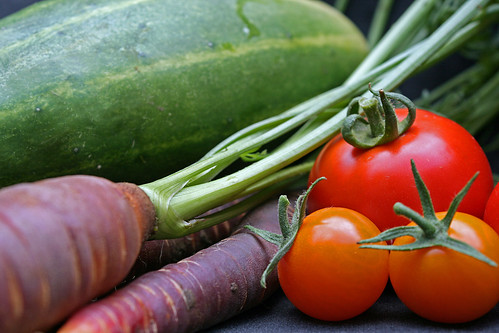
4) Make it fun. It's not like I force my kids to eat things they hate. They can go to the farmer's market or store with me and pick out whichever veggies and fruits strike their fancy. We like to include all sorts of different veggies in our repertoire: jicama sticks, snap peas, lightly steamed broccoli with teriyaki dipping sauce, carrots with hummus, cucumbers with tzatziki, seaweed snacks, kale chips, and the good old Big Ass Salad. Having our own garden for years has been the best way to make sure they eat lots of veggies. When you can go out the back door and pick the snap peas yourself, they taste infinitely better. And we can grow fun stuff like purple carrots and little orange tomatoes.
So this is how it comes to pass that when we went to a Red Robin's for dinner on a road trip recently, my son orders a chicken caesar salad, and my daughter asks for a steamed veggie teriyaki bowl (which has been her favorite for years and for some reason they just cut from their menu. Boooo Red Robin!). It never ceases to amaze the waiters. The fact that they always comment on my kids' food choices makes me realize how rare they are.
With the words "childhood obesity epidemic" on everyone's big worry list, it's clear that it's time to take kids' nutrition back into our own hands and put the phrase "Eat your vegetables" back into the national vocabulary.
Thursday, October 27, 2011
Kitchen Makeover, Paleo Style

For that matter, why have a toaster, much less a toaster AND a toaster oven taking up space on your counter? I have a very small kitchen. The woman who designed and built our house lived alone, and apparently didn't consider that someone who had to cook for more than one person would ever inhabit this kitchen. That's why we have the smallest refrigerator available on the market (just TRY to cram enough food for a 15 year boy into a fridge that's shorter than I am!), and very little counter space. So when the opportunity comes along to increase my available food preparation area, that's something I should jump at.
Voila, one day recently it hit me: I don't need any of these bread-altering implements, because I no longer eat bread. What a freeing concept. So away the appliances went to a bottom shelf somewhere and suddenly I have a whole lot more counter space than I've had in the 12 years we've lived here. NICE. Since I spend a lot more time cutting vegetables and meat these days, it's great to have the extra space to do so.

Paleo Update:
While I'm at it, a paleo eating update might be in order: I'm still eating mostly paleo, I say mostly because we buy local raw goat's milk and I occasionally put that in my smoothies or coffee. I will also eat rice from time to time, especially if we go for my favorite Thai restaurant and their salmon-pineapple curry. Yummmm.....

Only Two Meals A Day?
I finally figured out a meal plan that works for our crazy family's schedule. I cook breakfast in the morning when we get up, and then I cook supper at about 3:30 in the afternoon. Those are our two main meals each day. The kids can get themselves snacks at around noon, and then we're all out of the house or busy from 4:30 - 8:00 most evenings for stuff like karate, robotics, swimming, and dance. So when we get home, it's another snack time. Two main meals and two main snack times seems to work best for our family. Otherwise, I was always stressed trying to cook dinner at 8:00 at night, and no one was really hungry for a big meal then anyways. I can't tell you what a relief it was to figure this out!
These days, with everyone worried about kids, nutrition, and childhood obesity, it feels good to have a plan in place to keep our kids active and eating well. As a parent, the number one lesson I've learned is it really doesn't matter what you say to your kids, it matters what you do. The example you set is what they learn from, so having our entire family eat nutritious meals and snacks, and get out to exercise every day, as well as walking and biking for transportation has been the key to raising healthy, happy, energetic kids and now (ulp!) a teenager.
Thursday, August 25, 2011
Triathlon Training Questions?? We've Got Answers!
Questions of the day: Nutrition, training while sick, and road biking vs. mountain biking while training for a triathlon.
Laura is training for the Iron Girl triathlon in Lake Tahoe (and I'm so excited to get to meet her at the race!). But, like anyone relatively new to the triathlon world, she has questions. Since these are things that many people might wonder, I asked her if it would be okay to answer them here, and she agreed. So here's the first one:
It's definitely true that nothing besides religion and politics has as many opposing viewpoints as the topic of nutrition! My views on nutrition guidelines can be summed up pretty simply: Eat simple, whole, non-processed foods. If you've followed my journey here from vegetarian to Paleo, you'll know that while I've always focused on a diet of high-quality local and organic foods, I'm also not averse to changing things up to achieve a better and more nutritious eating plan. And recently I've been tweaking my Paleo ways to include more carbohydrates for endurance fueling.
When it comes to hunger, there are some important questions to ask. The first is, are you getting enough calories in? When you start training more, you get more hungry! This seems like such an obvious thing, yet a lot of us get used to "how much food I eat", and are reluctant to eat more than that, especially if we are worried about gaining weight. The fact is, how much you eat is directly influenced by how much you burn. I may eat 30 - 50% more food on a heavy training day than on a rest day, and I'm always amazed at how little I eat on my days with no workouts. It really doesn't take all that much food to keep a sedentary body going, yet it can sometimes take huge amounts of food to fuel an athlete's body. So the first thing to do is to make sure you're eating enough. If you're curious about calories in vs. calories out, you can use an application like Sparkpeople.com or FitDay.com (both of which have Android and iPhone apps) to track how much you're burning (including workouts) and how many calories you're taking in.
The second part of the equation is meeting your body's specific needs. If you're training hard, you are burning through glycogen, which you then need to replenish, hence the need to eat at least a certain amount of carbohydrates. Luckily, carbohydrates also fall fairly high on the satiety index, so they help you feel fuller longer. Sometimes that "empty tank" feeling is simply your body's glycogen fuel stores getting low. I've come to be able to distinguish between what I call "stomach hunger" (the familiar rumbling belly) and "body hunger" which is more an overall sensation of needing fuel.
Many people find that adding more fat to their diet helps them feel full longer. Healthy fats like olive oil and coconut oil are great for this (in fact, I had an athlete friend who swears by a tablespoon of oil when he starts feeling hungry). Now that we are far from the fat scare of the late 1990's ("eating fat will make you fat" was the motto of the Snackwell generation) and hopefully know better, we can make good choices regarding getting fats from great sources like eggs, fish, grass-fed meats, nuts, and seeds. I almost always start my day with two eggs combined with something (veggies, bacon, or coconut/banana are three favorite options) and that helps me avoid the hunger-crazies through the morning.
Hopefully that's helpful and you can avoid that afternoon burn out by fueling your endurance workouts! Next question:
1) Wear girlie clothes. Sorry guys, but studies show that drivers are far kinder to female cyclists than to males. They even give them way more room when passing. Anecdotally, I've noticed that when I wear my flowered cycling shirts, I get more consideration than when I wear the green/blue/black team kit. So flaunt your flower power and get some pink/orange/girlie jerseys!
2) Give yourself some room. Unless there's a wide shoulder or bike path, I don't ride right on the edge of the lane. It's useful to take up a little room in the lane, not so much that cars can't get around you, but enough that if you swerve around a stick or rock, or get buffeted by the draft of a big truck, you won't go flinging into the gravel shoulder.
3) Be courteous to drivers and obey traffic rules. Know your state's laws for cyclists (including hand signals) and use them. I always try to send very clear body language to drivers to let them know what I'm doing. A big left arm out, encased in neon yellow is an easy sign that says I'm turning left. Don't make tentative gestures.
4) Wear great reflective gear, blinkies, and lights. A blinkie during the day is even a good idea, and my reflective gear has saved my life in dusk-like riding conditions. For the most part, drivers want to see you, and are happy when you provide an easy way for them to spot you in plenty of time.
As for training on a mountain bike, sure! Make sure you're comfortable on your road bike since the saddle, seat angle, and strain on places like wrists or lower back may be different than on your mountain bike, but go ahead and put in some of your training time on your mountain bike as well. I know the year that my hubby took up mountain biking he became a monster climber on the road bike. It's great training for those hills!
Last question:
Laura is training for the Iron Girl triathlon in Lake Tahoe (and I'm so excited to get to meet her at the race!). But, like anyone relatively new to the triathlon world, she has questions. Since these are things that many people might wonder, I asked her if it would be okay to answer them here, and she agreed. So here's the first one:
The whole topic of nutrition makes my head spin. There are so many different ideas about what is best. My understanding is nutrition should be viewed as fuel for the body yet I am having trouble filling my tank! I am hungry ALL the time. I graze on wholesome foods during the day but, the hunger comes back within a half hour or so. Do you know of any foods or perhaps the timing of when I eat that will help me feel fuller longer? Also, if you know of any foods that seem to do a better job at sustaining energy throughout the day, I would love some ideas. Some days I am wiped out by three o'clock. I realize this can probably be a tricky question because we are all unique. I would be appreciative of your input on general nutrition guidelines an endurance athlete should follow.
It's definitely true that nothing besides religion and politics has as many opposing viewpoints as the topic of nutrition! My views on nutrition guidelines can be summed up pretty simply: Eat simple, whole, non-processed foods. If you've followed my journey here from vegetarian to Paleo, you'll know that while I've always focused on a diet of high-quality local and organic foods, I'm also not averse to changing things up to achieve a better and more nutritious eating plan. And recently I've been tweaking my Paleo ways to include more carbohydrates for endurance fueling.
When it comes to hunger, there are some important questions to ask. The first is, are you getting enough calories in? When you start training more, you get more hungry! This seems like such an obvious thing, yet a lot of us get used to "how much food I eat", and are reluctant to eat more than that, especially if we are worried about gaining weight. The fact is, how much you eat is directly influenced by how much you burn. I may eat 30 - 50% more food on a heavy training day than on a rest day, and I'm always amazed at how little I eat on my days with no workouts. It really doesn't take all that much food to keep a sedentary body going, yet it can sometimes take huge amounts of food to fuel an athlete's body. So the first thing to do is to make sure you're eating enough. If you're curious about calories in vs. calories out, you can use an application like Sparkpeople.com or FitDay.com (both of which have Android and iPhone apps) to track how much you're burning (including workouts) and how many calories you're taking in.
The second part of the equation is meeting your body's specific needs. If you're training hard, you are burning through glycogen, which you then need to replenish, hence the need to eat at least a certain amount of carbohydrates. Luckily, carbohydrates also fall fairly high on the satiety index, so they help you feel fuller longer. Sometimes that "empty tank" feeling is simply your body's glycogen fuel stores getting low. I've come to be able to distinguish between what I call "stomach hunger" (the familiar rumbling belly) and "body hunger" which is more an overall sensation of needing fuel.
Many people find that adding more fat to their diet helps them feel full longer. Healthy fats like olive oil and coconut oil are great for this (in fact, I had an athlete friend who swears by a tablespoon of oil when he starts feeling hungry). Now that we are far from the fat scare of the late 1990's ("eating fat will make you fat" was the motto of the Snackwell generation) and hopefully know better, we can make good choices regarding getting fats from great sources like eggs, fish, grass-fed meats, nuts, and seeds. I almost always start my day with two eggs combined with something (veggies, bacon, or coconut/banana are three favorite options) and that helps me avoid the hunger-crazies through the morning.
Hopefully that's helpful and you can avoid that afternoon burn out by fueling your endurance workouts! Next question:
The other thing is biking. I am mountain biker. I love the tranquility of riding in the dirt and through the trees. Recently, I dusted off my road bike for the first time in three years. This bike certainly handles the road much better than my moutain bike. However I am not accustom to riding near traffic! I need to shake the road riding jitters. Do you have any important road biking saftey or ettiquette tips (besides the obvious like wear your helmet and pray) that I should follow? I just want to be sure that I am not missing any important safety items, especially when I am making left turns or when the bike lane crosses between the right hand turn lane. Also, if I do some of my training rides on my mountain bike will that still be adequate training for the road coarse? Or will I be short changing myself?I completely understand - I love being off of the main routes of traffic and I know how nerve-wracking it can be to ride close to cars. My tips are as follows:
1) Wear girlie clothes. Sorry guys, but studies show that drivers are far kinder to female cyclists than to males. They even give them way more room when passing. Anecdotally, I've noticed that when I wear my flowered cycling shirts, I get more consideration than when I wear the green/blue/black team kit. So flaunt your flower power and get some pink/orange/girlie jerseys!
2) Give yourself some room. Unless there's a wide shoulder or bike path, I don't ride right on the edge of the lane. It's useful to take up a little room in the lane, not so much that cars can't get around you, but enough that if you swerve around a stick or rock, or get buffeted by the draft of a big truck, you won't go flinging into the gravel shoulder.
3) Be courteous to drivers and obey traffic rules. Know your state's laws for cyclists (including hand signals) and use them. I always try to send very clear body language to drivers to let them know what I'm doing. A big left arm out, encased in neon yellow is an easy sign that says I'm turning left. Don't make tentative gestures.
4) Wear great reflective gear, blinkies, and lights. A blinkie during the day is even a good idea, and my reflective gear has saved my life in dusk-like riding conditions. For the most part, drivers want to see you, and are happy when you provide an easy way for them to spot you in plenty of time.
As for training on a mountain bike, sure! Make sure you're comfortable on your road bike since the saddle, seat angle, and strain on places like wrists or lower back may be different than on your mountain bike, but go ahead and put in some of your training time on your mountain bike as well. I know the year that my hubby took up mountain biking he became a monster climber on the road bike. It's great training for those hills!
Last question:
What happens when you catch a pesky head cold during training? =( Can I keep going and watch and see how my body feels? Will throttling back on the training hurt me race day?Taking a few days off to recover shouldn't hurt you much on race day, but more than 4 or 5 might start to have an effect. Generally, I'll train through a light cold, but if I feel it start to go into my lungs or if I'm running a fever, I give it a rest. Also, my sister makes this awesome soup that has a ton of cayenne and garlic in it. If you feel a bug coming on and drink a couple bowls of that stuff, it knocks that pesky cold right outta the ballpark.
Tuesday, February 08, 2011
Paleo Challenge: The Report, Part 1

The Sugar Monster
After just a few days, my sugar cravings were completely gone. You might remember that just a couple of months ago I was craving sugar like a heroin addict looking for a hit. So to have it depart so suddenly, to be able to open up a cupboard and look at a pound of chocolate, or to dish out an entire pan of lemon bars to hungry teenagers and not have a single bit, that's pretty amazing, right? Well, I think it is. I've lived with the Sugar Monster my entire life. I remember walking to the store as a 12 year old to replace with my crumpled up bills of allowance money an entire quart of ice cream I'd eaten,
 so my parents wouldn't find out and get mad at me. How screwed up is that? I ate so much sugar, I had a yeast Army living in my body. I actually got thrush as a teenager and the doctor said that was so unusual he'd never seen it except in babies and seriously ill old people.
So the fact that this Sugar Monster was just {poof} GONE is amazing all by itself.
The Thyroid Horror Show
The next issue I was wondering about was my thyroid. One of the things that spurred me to take the Paleo Challenge was that my doctor had recently decided to lower my thyroid medication (possibly because the earlier switch to mostly Paleo made my thyroid actually start working again, hooray!). Whenever they muck with your medication, Bad Things Happen. Like you hair starts to fall out, you get incredibly cold, your skin gets scaly, muscles get achy, and you gain weight like nobody's business. The last time my medication got mucked with I gained 13 pounds in about three weeks. It's crazy. So this time when they changed my medication I watched all of this happen and decided that if Mostly Paleo was good news for my thyroid then 100% Paleo might just stave off the Thyroid Horror Show.
You know what? I was right. By the time I started on the Challenge, I'd reduced my medication (per doctor's orders) by 25%. I was already starting to experience some of the thyroid symptoms (very very cold for one thing) and had gained 5 pounds. But by a few days into the Challenge, it all stopped. Within a week I wasn't cold anymore, and my family was happy that I didn't have to roast them out with the heaters. My muscle cramps stopped. The weight gain stopped, and within three weeks I'd lost it all back to my regular body weight. Pretty powerful stuff.
No Carb Exercise???
Through it all, I've continued both aerobic and anaerobic exercise. I've run as much as an hour and a half on the trail with no carbs whatsoever (and doesn't that run counter to conventional exercise "wisdom"??). My typical pre-workout breakfast is a big egg-and-veggie scramble. No bagels, toast, or even a banana to get those carbs flowing. Post workout snacks are jerky, and maybe some carrots. For fruit I've mostly stuck to frozen berries that we picked last summer. I have had a few bananas and half an apple here or there, but no serious carbs.
So without fueling with carbs, I've worked out an average of 13.5 hours a week, with a low of 11 and a high of 15.5. I've done weights, crossfit, trail running, kickboxing, Master's swimming, karate, track workouts, and taught Karate Conditioning without feeling underfueled or under-recovered. In fact, my recovery is pretty amazing.
For instance, my Tuesdays include an hour to hour and a half of Karate in the morning, then an hour long hike with my dogs at noon, two hours of Karate in the evening (which often includes bodyweight work like pushups, situps, squats), and Karate Conditioning at 7:00. By the time I get home, I've exercised for 4 - 4.5 hours, some of it very high intensity (like today included sparring matches). I wake up Wednesday morning feel fresh as a daisy.
In A Nutshell: The Wrap-Up
At age 44, having that kind of energy is, well, nothing short of miraculous. So that's the first installment of my Paleo Report: Sugar Cravings Gone, Thyroid Stabilized, Incredible Fueling for extreme workouts. I call that success.
Tomorrow: What did I eat?
Wednesday, March 31, 2010
Paleo Friends and Family Challenge
If anyone wants to virtually join in, the 6-week Paleo Challenge is on. My mom, my daughter, hubby, and some friends are all joining in.
So far I've completed 6 weeks of Paleo myself, with only one real cheat day (yesterday went out for an awesome burger and chocolate malt with birthday gal Carrie).
 Results so far for me: 11.5 pounds GONE, also down 3.5 % body fat so I have been losing fat, not muscle. Just had to pile up a whole ton of clothes that no longer fit to give away to Goodwill.
The rules are simple:
1) Think about what a paleolithic hunter-gatherer would eat
2) Eat that
Okay, so maybe it isn't that simple to eat like a caveman in modern times. So here's some basic guidelines:
1) Every meal consists of meat or fish + 1/4 to 1/2 pound of vegetables (yes, you heard me right!)
2) No legumes, potatoes, rice, grains (yes this means no PB&J sandwiches, no soy, no peanuts, bread, pasta, etc.). Tree nuts are fine.
3) Fruits and starchy veggies like yams, squash, sweet potatoes only after a workout, and only in moderation.
4) Strict paleo is no dairy. Okay, I do cheat on this one since we drink raw milk and I think it's a great protein source. You can decide for yourself on this one. For sure no sugary yogurts or highly processed cheese food substances.
5) No sugar
6) Limit of 4 alcoholic drinks a week (not all in one day!) Red or white wine is fine, no beer. Yes, beer is made from grain.
I think that's it. It's a good idea to take some "Before" photos and measurements, as well as weight and body fat. If you've recently had blood work done (cholesterol, etc.) that's another good point for comparison later. You don't have to share this info with anyone, but if you want to later that's good too!
So far I've completed 6 weeks of Paleo myself, with only one real cheat day (yesterday went out for an awesome burger and chocolate malt with birthday gal Carrie).

The rules are simple:
1) Think about what a paleolithic hunter-gatherer would eat
2) Eat that
Okay, so maybe it isn't that simple to eat like a caveman in modern times. So here's some basic guidelines:
1) Every meal consists of meat or fish + 1/4 to 1/2 pound of vegetables (yes, you heard me right!)
2) No legumes, potatoes, rice, grains (yes this means no PB&J sandwiches, no soy, no peanuts, bread, pasta, etc.). Tree nuts are fine.
3) Fruits and starchy veggies like yams, squash, sweet potatoes only after a workout, and only in moderation.
4) Strict paleo is no dairy. Okay, I do cheat on this one since we drink raw milk and I think it's a great protein source. You can decide for yourself on this one. For sure no sugary yogurts or highly processed cheese food substances.
5) No sugar
6) Limit of 4 alcoholic drinks a week (not all in one day!) Red or white wine is fine, no beer. Yes, beer is made from grain.
I think that's it. It's a good idea to take some "Before" photos and measurements, as well as weight and body fat. If you've recently had blood work done (cholesterol, etc.) that's another good point for comparison later. You don't have to share this info with anyone, but if you want to later that's good too!
Wednesday, July 15, 2009
What's Good For Your Body is Good For the Planet
 It's funny how we athletes train so hard, look at all of our metrics, try to improve in ways large and small and yet....when it comes to nutrition there we are unwrapping a blob of processed soy protein isolate, fractionated Palm Kernel oil and even the devil incarnate high fructose corn syrup and wolfing it down. No, not even wolfing it down - I'd put a bet that any self-respecting wolf would turn up its nose at such a concoction (just as our family dog once turned up his nose at my offer of a tofu hot dog - HE knew it wasn't a meat substitute!)
So in my ever-ongoing process of synthesizing the various elements of my life into some sort of a meaningful and coherent whole, it struck me that what is good for the planet (there's that tree-hugging side of me) is best for our bodies (there's that triathlete side) and vice-versa. I'm trying to move in a mostly whole-foods direction for nutrition, which has left me strangely deprived of power bars, drink mixes, and gu-like substances for all of my training so far this summer. I'm trying various combinations of dates, sunflower seeds, coconut, and dark chocolate for training fuel and the rest of the time trying to stick to a loosely paleolithic (plus raw milk and eggs) kind of nutrition plan.

Post-workout re-fueling has been supplied by smoothies consisting of raw goat's milk, our own chicken eggs, and various berries that we've picked locally and frozen.
In so many races I just feel sick of eating sweet stuff (especially when downing a drink mix, even one as mild as the Accelerade that I like to use), so for our upcoming Cascade Lakes Relay in a few weeks, I'm going to try out the Slipstream cycling team's Rice/Egg cakes. Here's a great video with their team chef explaining how (and why) he makes these for the team. Don't those sound great in place of yet another sweet gooey energy bar??
 I do have to note though that if he was using eggs like the ones we get from our free-ranging chickens, they would look much nicer and yellower in his pan than those pale versions he's got going there. Just for comparison, here's a store-bought egg (and mind you, this is an organic "free range" storebought egg, not just a regular factory-farmed egg) on the left in the pale yellow, and one of our chicken's eggs on the right in the rich deep gold/orange. Notice how the white parts of the storebought egg have run all over the place while our chicken's egg is standing firm. Yep, even when you get down to splitting hairs like buying your organic eggs from the regular grocery or from someone whose chickens you can see running around the pasture, sourcing it locally matters. It may even be the case that to reach your full athletic potential, a few workouts could be swapped with time in the veggie garden.
What's good for our bodies is good for our planet is good for our communities and our farmers.
Wednesday, July 01, 2009
Made of Iron, But Not the Kind You're Thinking Of
 Looking back on my 10k TT debacle this week, I'm also looking at another possibility: my old friend Anemia might be back in town. Just realized that I ran out of iron tablets a few weeks ago and it's been on my to-do list to pick up some more. The way anemia works is it sneaks up on you. One day you're running 10 miles and before you know it a week or two later you're gasping for breath when you walk up the stairs. Luckily, there's a pretty easy fix, and since I started taking iron tabs again last night, hopefully I'll know whether or not that's a contributing factor soon enough.
I know some people get anemia in pretty mild forms, in fact it's common in women and very common in athletic women. For some reason, I seem to have a real problem making red blood cells, and have since I was a kid. Various tests have been run over the years with no conclusions about my faulty blood cell factory (no I don't have leukemia, no I don't have nutritional deficiencies, etc. etc.) In fact, it was serious, life-threatening anemia that derailed my first Ironman attempt and had my doctor threatening me with a blood transfusion (not to mention threatening to take a baseball bat to my bicycle if I even got on the thing again until my hematocrit came back up).
From as early as eight years old, I had pica, a condition in which you crave eating strange things (dirt, chalk, ice, paper) and which is frequently caused by anemia. While I was a vegetarian later in life, my family definitely wasn't that way when I was growing up. I remember once when my dad was the grand marshall of the rodeo, one of the bucking bulls threw his back out and they had to shoot him. So we had 400 pounds of "Black Magic" or "Hell's Fury" or whatever the bull's name was in our freezer that year. Needless to say, I wasn't anemic for lack of eating red meat. But I got in trouble frequently at school for eating chalk and paper, and at home I ate so much ice that my dad dismantled the ice maker in our refridgerator. Of course, no one knew that my strange eating habits were really the result of a medical condition, which was very curable.
Once in college, I unknowingly compounded my problems by becoming an athlete, and then a vegetarian. What followed was 20 years of serious battles with anemia in which my blood count would get so low that my doctors couldn't believe I was still standing in front of them (not to mention training for triathlons, climbing mountains, etc.). I'm just stubborn that way I guess. The red blood cell count of a dying cancer victim and I can't be dissuaded from my plans. Eventually after my docs endless pleading and the fact that I could no longer tolerate the massive amounts of iron I needed to take just to stay on the low end of normal, I gave up my vegetarianism. That was just a few years ago and though it took awhile to adjust to eating meat again, I think that's what allowed me to train and complete the Ironman finally (and no, the pun of that name wasn't lost on me at the time!)
So now, I really only have to take one small iron tab a day to stay in the boundaries of low-normal. It's not too much to stay on top of, except that for some reason my brain thinks I can slack off on this and still be okay. Until I'm not. Right now I'd place money on the fact that I'm not. Maybe that's not the only reason I had such a crappo run this week, but I'd bet that it's a big contributing factor. So if you've made it this far in this blog post, keep your fingers crossed for me. And if you know anyone who ever confesses to feeling urges to eat strange things like freezer ice or paper straw wrappers, maybe you'll know why!
Monday, September 24, 2007
Black Diamond Half-Iron Race Report: Nutrition Lessons

Black Diamond Half-Iron Distance: First up, the good news: I set a PKPR (post-kids PR) for this distance at 5:39:42, and an all-time PR at this distance on the bike course at 2:52:11. I also had the 2nd fastest women's swim split. Given that I had very low expectations going in, with only two bike rides over 50 miles this summer, and one long run of 12 miles or over, I am extremely happy with my overall performance. I'm especially excited about my continued improvement on the bike in every race this year. The bad news: other than my lack of training, I was really held back by poor race day execution (transitions and details) which led to a nutritional crisis and almost my first DNF ever. You would think after 21 years in the sport, I'd be above these stupid little mistakes, but you would be wrong on that one.
So, on to the race. It was very cold on race day morning. I had expected it to be cold, but somehow it felt a lot colder to me than I had even expected. So after heading out on the bike to warm up before the race, I second-guessed my original plan of wearing my cycling jersey and arm warmers and instead decided to wear a jacket. I don't have any really good tight-fitting cycling jackets, so this was a painful decision for me, knowing I was sacrificing aerodynamics for comfort. I definitely think I need to get some cold-weather gear if I'm going to race longer distances this late in the season again, especially in the fickle Northwest. This jacket decision had consequences that rippled out later in the day. Since I was wearing a jacket and not my jersey on the bike, I decided to pin my race number onto my running shirt and not wear the race belt to hold my number. I've always raced with a race belt, so this was a departure for me (mistake #1). It would also mean I'd have to grab some gels for the run and hold them in my hand instead of having them in my belt. I made sure to put them by my running shoes so I wouldn't forget them.
I was worried about the swim being too cold, as the lake was 61 degrees on race morning. That turned out to be a non-issue though, and my new Blue70 long-sleeved wetsuit worked like a charm. I added a neoprene cap and was toasty and felt smooth and fast. With only one woman out ahead of me, I wove through the slower men from the preceding heat to a very nice swim split. It was slower than I estimated (30:47, when I predicted :28), but since everyone's splits were slow I think that was a swim course issue and not my personal speed. I was the 2nd woman and 13th overall swimmer.
On to the transition. Pulling on my jacket proved to be ridiculously difficult. Should've practiced it with wet arms, I had practiced arm warmers over and over, but again it was a last-minute decision to change. This left me with a very slow T1 of 3:37. On the other hand, I felt toasty warm and comfortable on the bike, even if I looked ridiculous in floppy jacket and aero helmet. However, the helmet kept my ears nice and warm as I had hoped. The bike course was really lovely. Smooth roads over most of the course, and the rolling hills that make me feel right at home. I felt powerful and kept a nice steady pace, rolling into a 2:52 bike split, which was 3 minutes faster than my estimated time. My nutrition felt spot on, and I was well hydrated and (here comes some TMI) even managed to pee on the bike, eliminating the bothersome porta-potty stops that slowed down my Ironman and last HIM bike splits.
T2 was not especially fast as I did change socks, but 2:11 was reasonable given the distance through the transition area that I had to run my bike. It was worth it to have comfortable feet on the run. I started out the run by keeping to my goal pace of 9:30. I didn't overamp the first couple of miles like I did last time at this distance, and was very happy with how my run course was going. There were some short, steep hills that were definitely a bitch, but I felt okay. At 30 minutes into the run however, I reached for my first gel and realized I forgot to grab them and I wasn't wearing a belt. There were no gels on the run course at the aid stations, only Heed (made by Hammer) and water. I decided to walk through the aid stations and try and drink more Heed than I normally would to keep my carbs up and blood sugar stable. This worked really well through mile 8, and I was having a pretty nice run. My first 6 miles was spot on a 9:30 pace at 57:03. After mile 8 however, the aid station (you pass it multiple times on this course) ran out of Heed and only had water. I still had almost 50 minutes to go and this worried me. Mile 9 went okay, but by mile 10 I was feeling slightly queasy and shaky. After that, I could definitely feel the low blood sugar taking hold and I hit the wall hard. I felt so shaky and my heart was hammering very hard, so I walked for awhile and tried to determine whether or not it was healthy to keep on or whether I should quit.
I've never DNF'd in a triathlon once in over two decades. But my pounding heartbeat and headache worried me. Passing out after the Ironman last year with such low blood pressure and dehydration had given me a good scare and worried me that I was able to push on for so long in that race with my body obviously failing. This is what was going through my mind on the Half-Iron course. Should I go on? I finally came to the conclusion that I was experiencing low blood sugar and not dehydration or anything life-threatening. So I started running again. Although the last two miles were very scenic, ending up on a lovely trail around the lake, they seemed to stretch out in a sort of miserable haze. I passed a couple of people who were experiencing very similar things and were walking, so I know I wasn't the only one caught by surprise when the aid stations ran out of carb drink.
In the end, I finished with a run split (2:10:56) only a bit faster than my last HIM run (2:12). I know I'm faster overall now, so this was pretty disappointing, and although I didn't have a lot of mileage under my belt, I think I could've done better if I hadn't messed up my nutrition. It's a good lesson to re-learn though, don't change things up on race day. If you remember nothing else, keeping your nutrition going in a long race is paramount.
Overall, I'm happy with my race. As always, the longer courses teach you a lot about racing, the importance of strong strategy and consistancy, and how tough you can really be. This one hurt worse than it should've, and I know I won't forget those lessons anytime soon! But on the bright side, I'm faster at 41 than I was at 38 and that's nothing to sneeze at. I'm also only a few minutes away from my all-time PR at this distance that I set at age 25. Maybe next time...
Friday, November 17, 2006
When Being Good To Your Body Feels Right
One of the greatest paradoxes of modern life is that we've reached a place where treating our body right feels wrong. Our culture and our media epitomizes exercise and eating right as the things we "should" be doing, but they make it sound like a difficult, and almost unattainable goal, one we will struggle to meet and perhaps never entirely achieve.
The question I hear asked most often when I talk or correspond (email, bulletin boards) with others about health and exercise is "How do I get to that place where doing the right thing feels right? How do I get to where I want to do it?"
Here's an answer I wrote recently for a discussion on a Health board. I thought it might be worth sharing:
I think the single biggest key is this:
Meaningful Change is Slow and Incremental
I think when we look for big, immediate change, we set ourselves up for disappointment. Our entire culture points to immediate change as the path of success, but instead it is most often the path of at the very least failure, and at the worst self-destructiveness.So when we immediately embrace (or think about embracing) some new diet or exercise regime, we are either in that place of euphoria, where we are actually doing it, or we're in that place of despair where we can't keep up with it, or we're euphorically planning the next big change. These steps both work against us and keep us from dealing with the real day-to-day issues that our thoughts about food and our thoughts about our bodies are hiding.When we throw this whole notion out the window that change will be immediate and all-encompassing, we begin to live in the here and now. We begin to have to exist and deal with whatever is happening to us now, today, this moment. We can also begin to make small, incremental changes that will carry us on a path to health and wellness and emotional stability (instead of the wild rollercoaster).
One of my mantras is "Walk in the Direction You Wish to be Going". Every day, we're faced with lots of choices. Which direction do we wish to be walking? In the direction of health? Or the direction of unhealth? Personally, I would divorce this decision-making from any notion of fat/thin. Thin is not necessarily healthy, fat is not necessarily unhealthy. Instead, think of good health.
So if I'm facing the refrigerator with an overwhelming desire to eat something sugary and fatty. Where does the desire come from? What will I gain from eating it? What thoughts am I trying to avoid by focusing on the notion that this food will make me feel better? What is the healthy choice, right here and right now? Sometimes the healthy choice might just be the piece of cake on the bottom shelf. That's okay, it's not a loaded gun. It won't kill you to eat a piece of chocolate cake if the rest of your steps that day are toward total body and mental health. If you can examine what is going on, and start to make choices toward health, if you can stop beating yourself up when you make a choice that takes you in an unhealthy direction, but instead just make the next choice for health, you will be walking on the path of health.
If you take one step today toward health, and if you don't beat yourself up for any other steps you take, if you can stop thinking in terms of fat or thin, stop making everything a loaded weapon to shoot yourself with (metaphorically), if you do those things, then I will bet that the next step you take toward health will be easier. And the next even easier. And some time in the future, probably not today or tomorrow or the next day or even the next week or month maybe, it will be easier to take a step toward health than a step toward unhealth. The healthy choices will become the ones you want to make. I am 100% convinced of this.
Be gentle on yourselves. The path always has detours and setbacks. Just start choosing health, because you deserve it, because it will feel good, and don't be harsh with yourself if you don't think you've chosen right. Remember that making yourself miserable is also a step toward unhealth, even if you eat carrots instead of cake.
The question I hear asked most often when I talk or correspond (email, bulletin boards) with others about health and exercise is "How do I get to that place where doing the right thing feels right? How do I get to where I want to do it?"
Here's an answer I wrote recently for a discussion on a Health board. I thought it might be worth sharing:
I think the single biggest key is this:
Meaningful Change is Slow and Incremental
I think when we look for big, immediate change, we set ourselves up for disappointment. Our entire culture points to immediate change as the path of success, but instead it is most often the path of at the very least failure, and at the worst self-destructiveness.So when we immediately embrace (or think about embracing) some new diet or exercise regime, we are either in that place of euphoria, where we are actually doing it, or we're in that place of despair where we can't keep up with it, or we're euphorically planning the next big change. These steps both work against us and keep us from dealing with the real day-to-day issues that our thoughts about food and our thoughts about our bodies are hiding.When we throw this whole notion out the window that change will be immediate and all-encompassing, we begin to live in the here and now. We begin to have to exist and deal with whatever is happening to us now, today, this moment. We can also begin to make small, incremental changes that will carry us on a path to health and wellness and emotional stability (instead of the wild rollercoaster).
One of my mantras is "Walk in the Direction You Wish to be Going". Every day, we're faced with lots of choices. Which direction do we wish to be walking? In the direction of health? Or the direction of unhealth? Personally, I would divorce this decision-making from any notion of fat/thin. Thin is not necessarily healthy, fat is not necessarily unhealthy. Instead, think of good health.
So if I'm facing the refrigerator with an overwhelming desire to eat something sugary and fatty. Where does the desire come from? What will I gain from eating it? What thoughts am I trying to avoid by focusing on the notion that this food will make me feel better? What is the healthy choice, right here and right now? Sometimes the healthy choice might just be the piece of cake on the bottom shelf. That's okay, it's not a loaded gun. It won't kill you to eat a piece of chocolate cake if the rest of your steps that day are toward total body and mental health. If you can examine what is going on, and start to make choices toward health, if you can stop beating yourself up when you make a choice that takes you in an unhealthy direction, but instead just make the next choice for health, you will be walking on the path of health.
If you take one step today toward health, and if you don't beat yourself up for any other steps you take, if you can stop thinking in terms of fat or thin, stop making everything a loaded weapon to shoot yourself with (metaphorically), if you do those things, then I will bet that the next step you take toward health will be easier. And the next even easier. And some time in the future, probably not today or tomorrow or the next day or even the next week or month maybe, it will be easier to take a step toward health than a step toward unhealth. The healthy choices will become the ones you want to make. I am 100% convinced of this.
Be gentle on yourselves. The path always has detours and setbacks. Just start choosing health, because you deserve it, because it will feel good, and don't be harsh with yourself if you don't think you've chosen right. Remember that making yourself miserable is also a step toward unhealth, even if you eat carrots instead of cake.
Wednesday, October 04, 2006
The Flesh Is Strong But the Stomach is Weak
I feel like I'm in tip-top form, all the muscles firing nicely. I can ride six hours, start running, and my legs hardly feel fatigued at all. I can picture myself making it through the Ironman without actually sitting down in the middle of the road and crying now.
There's only one major weakness that I'm worried about. My stomach. I guess I didn't encounter this particular bugaboo when I trained for the marathon and half-Ironman, because they don't last this long. Somewhere about 5 1/2 hours, my stomach just up and quits functioning, folds up shop, throws in the towel. I'm worried. I don't really want to crawl across the finish line, heaving my guts up. And I definitely don't want to DNF because my alimentary system is in shut-down mode.
So this week's long ride, in addition to being a gear check, will be to try a new policy: no solid food on the bike whatsoever, and I'm going to try taking a Dramamine before heading out. After reading about IM Florida seasickness issues on the BBS, I was going to try that out anyways. I'm notoriously green around the gills in the slightest oceangoing vessel (odd for someone who has flown in aerobatic airplanes without a hitch, but there you have it). So we'll see if the dramamine has the added benefit of quieting the queasies.
There's only one major weakness that I'm worried about. My stomach. I guess I didn't encounter this particular bugaboo when I trained for the marathon and half-Ironman, because they don't last this long. Somewhere about 5 1/2 hours, my stomach just up and quits functioning, folds up shop, throws in the towel. I'm worried. I don't really want to crawl across the finish line, heaving my guts up. And I definitely don't want to DNF because my alimentary system is in shut-down mode.
So this week's long ride, in addition to being a gear check, will be to try a new policy: no solid food on the bike whatsoever, and I'm going to try taking a Dramamine before heading out. After reading about IM Florida seasickness issues on the BBS, I was going to try that out anyways. I'm notoriously green around the gills in the slightest oceangoing vessel (odd for someone who has flown in aerobatic airplanes without a hitch, but there you have it). So we'll see if the dramamine has the added benefit of quieting the queasies.
Subscribe to:
Posts (Atom)